Price history, listings and card analysis
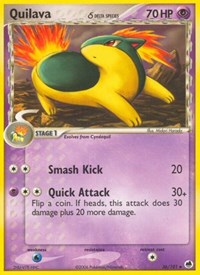
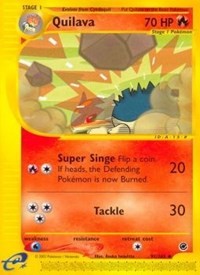
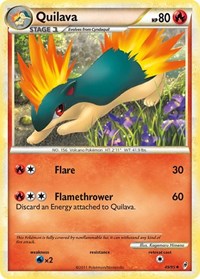
Quilava (Delta Species) 36/101 EX Dragon Frontiers (Normal). TCGplayer market price: $4.18 as of Oct 1, 2026. Recorded price history: 967 daily market-price observations, Feb 8, 2024 to Oct 1, 2026. 12-month recorded market-price range: $1.33 – $4.18. TCGplayer lowest listed ask: $0.95 as of Oct 1, 2026, across conditions, before shipping. TCGplayer listed median: $2.86 as of Oct 1, 2026. Pokespective interest score: 43 out of 100 (Ordinary); It ranks above 43% of the cards we track. 60-day price forecast: An estimated 58% chance of beating the typical tracked card over 60 days; in a typical outcome it would end about 1.7% ahead. Four times in five the price lands between $3.99 and $5.14. This card's pricing is flagged, so treat the forecast as unusable rather than merely uncertain. 60-day forecast: Likely range: $3.99 – $5.14; 8 in 10 outcomes. 60-day forecast: Middle half: $4.20 – $4.72; half of outcomes land here. 60-day forecast: Typical outcome: $4.42; +1.7% versus the market. 60-day forecast: Confidence: 87 / 100; a narrow range, not a better outcome.
Beating the market, or just riding it?
Not enough trading to say
It trades too rarely, or has too little recent price history, for a 2-month comparison with the market to mean anything.
Describes the last 2 months, not what happens next. Not investment advice.
Is this card interesting right now?
Ordinary - 43 out of 100
It ranks above 43% of the cards we track. The score describes the conditions around the card today - how sellers are pricing it, how it is trending, how steadily it trades. Its weights were tuned on how cards moved over the following 60 days, so a high score is a tendency across many cards, not a forecast for this one - and it says nothing about whether you will enjoy owning the card.
Why is it interesting?
Sellers undercutting and climbing for 2 months
Median asking prices sit below the recent-sales market reference - sellers are pricing more aggressively. It has done better than the market over two months, which is long enough to be a trend rather than a blip.
Is it becoming more popular?
Yes - consistently
Compared with the Pokemon market as a whole, so a rising tide does not count as popularity. In this market these trends have tended to keep going rather than reverse.
Past month+3.7%
Past 2 months+14.1%
Past 4 months+38.3%
Is it expensive or cheap?
$4.18 - mid-priced for its set
At $4.18 it is mid-priced for its set - number 121 of 190 by price. It costs more than 82% of other Uncommon cards we track. It is at or near its highest price of the past year.
What makes this card unusual?
An ordinary Uncommon from a 20-year-old set
Uncommon is a widely printed rarity - 11,470 tracked cards share it. The set is about 20 years old, so surviving copies in good condition get scarcer over time.
Could you actually buy or sell it?
Slowly - it rarely trades
The price changed in 23% of our checks over the past year across 365 observations. TCGplayer's market price only updates when a copy sells, so a low figure means the price shown may be stale and any trend reading is built on very few real sales.
How does the grading fee compare?
Fee exceeds raw price
A roughly $22.00 grading fee is 526% of the $4.18 raw price. Raw price plus fee comes to about $26.18, before shipping, insurance or selling costs. That is a cost comparison, not an estimate of a graded copy's value. We track raw ungraded prices only - no graded sales and no population data. We cannot assess this copy's condition or tell you what a PSA 10 is worth. Check condition and comparable graded sales before deciding whether grading would pay off.
TCGplayer market price on the last day we have for each month; the current month so far.